May 2025.
At the start, the idea was simple. Really simple.
A man with a tormented past. A woman living the daily hell of a violent husband, one of those very human monsters who need nothing supernatural to do damage. He helps her. A romance is born. They go off to settle in an old manor. And there, slowly, the fantastical creeps in.
There. A story I could hold in one hand. The kind of project where you tell yourself, “come on, a few months and it’s done.”
Then I had a fatal thought.
“More Twilight-style vampires? No.”
That’s exactly the moment when everything tipped over.
I refused the déjà-vu. No way was I pulling yet another sparkling vampire out of the hat. If I was going to do the fantastical, I wanted it to be believable. Grounded. So that nobody could tell me “oh yeah, that one’s lifted straight from so-and-so.”
So I decided to rethink the origins. All of the origins.
And that’s how you calmly start digging a hole you’re going to spend the next several months in.
The vertigo of credibility
I wanted my characters to come from somewhere real. Real cities, real eras, real historical upheavals.
My heroes had to be French. Fine. But from which city? In which era? And how do I get them to the United States in a plausible way? Small problem: in the period I was interested in, France and England were at war. Crossing the Atlantic was no pleasure cruise.
So I rewrote. They’d be Huguenots of Rouen, fleeing the dragonnades. Elara, for her part, would come from the Palatinate, on the run from the witch hunts, and would learn French in Amsterdam among them. Since she’d leave first for the New World, she’d be guided by the Wabanaki, allies of the French (of course, because the geopolitics had to hold up too).
Every decision triggered three more. A date that didn’t line up with a war. A route that made no sense. A people allied with the wrong side. I rewrote my origins again. And again. And again.
Then I told myself I needed a first immortal, long before all that. Which led me to the Vikings and their discovery of Vinland, in North America. Because if I was doing real History, I might as well go all the way back to the actual first Europeans to set foot on the continent.
You see the picture. I wanted to write a romance. I found myself checking dates of dragonnades and Viking sea routes at ungodly hours.
Then I added a layer. Then another.
Since my first part was anchored in realistic horror, that of the violent husband and the suffocating everyday, I needed to build anticipation. To ratchet up the fantastical tension without giving it all away.
Hence the idea of the interludes. Four fantastical breaks, in four eras and four different places, showing the same ritual attempted across the centuries, with varying degrees of success. An opening in ancient Greece. A stop in Vinland. One in Japan. And a last one in Wallachia, where a certain Vlad the Impaler deliberately corrupts the ritual and becomes the very first undead. The first vampire.
Three thousand years of History to hold together. Location sheets, character sheets, eras that echo one another.
And I might have pulled it off. If I hadn’t had that idea.
The character who nearly drove me out of my mind
One of my characters weaves the whole story together. For three thousand years.
She sees the probabilities. She orchestrated everything, patiently, across the millennia, because it was the only way to defeat the three antagonists. Three millennia-old beings themselves, descended from the Mound Builders, whose real disappearance as a civilization I made the consequence of their doings.
She warns the hero’s ancestors of the coming dragonnades and leaves them a message: flee to Amsterdam. She helps Elara leave the Palatinate for that same Amsterdam. She causes, or prevents, a thousand tiny events. An accident here. A sudden refusal to go to a certain place. A systematic win at rock-paper-scissors, because she sees the moves coming, literally.
And the trap, the magnificent trap I set for myself: she is never named. The reader must not spot her too soon. Her interventions are doled out, discreet, seemingly trivial. But all of them have to be consistent with one another, across three thousand years, without the slightest contradiction.
Which means that I, the author, had to keep track of every single one of her moves played in advance. Every clue sown in a chapter had to fit perfectly with an event that happened five centuries earlier. A detail slipped in on page 300 had to make sense with a scene in Vinland.
Impossible to hold in one head. Mine, at any rate.
Notes everywhere, and the thread slipping away
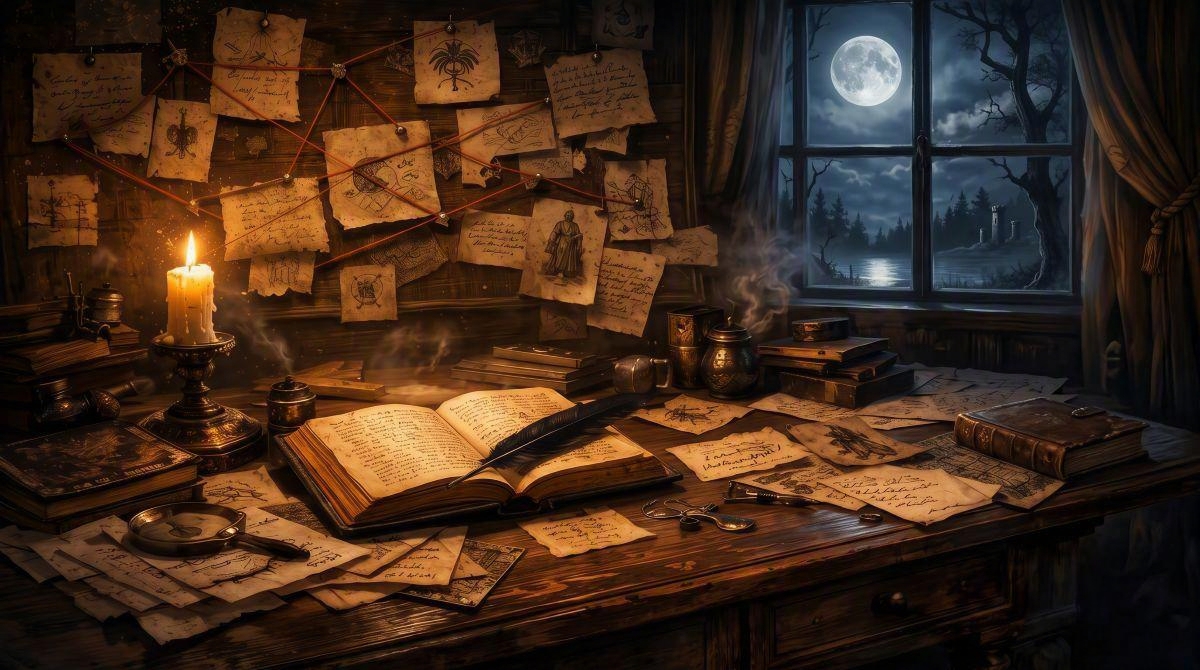
So I took notes. Everywhere.
On my desk. In my phone. In three different files that didn’t talk to each other. On scraps of paper, half of which I could never find again.
And here, a confession. I never saw the time pass. It was pure intoxication: building this world, pulling a thread and discovering where it led, making a date fit a myth, a myth fit a character. Hours evaporated without my noticing.
But there was this nagging, persistent feeling that spoiled the party: the sense of losing ideas along the way. A brilliant find at 2 a.m., jotted down somewhere… and nowhere to be found the next day. A clear, dazzling train of thought that frayed apart for lack of a trace. The vertigo of feeling that my universe was bigger than my ability to hold on to it.
I had built a three-thousand-year cathedral. And I was keeping it on Post-its.
It wasn’t a bug. It was… okay, fine. Yes. It was one. A big one. And I had to fix it.
But that’s a story for the next episode.